Outdoor lighting sconces are often overlooked in home improvement plans, yet they transform how your house looks and feels after dark. Unlike overhead porch lights that wash everything in flat brightness, sconces deliver focused, directional light that highlights architectural details, creates warm gathering spots, and boosts security without harsh glare. Whether you’re mounting them beside your front door, flanking a patio, or lining a garden pathway, the right sconces blend form and function seamlessly. This guide walks you through what to look for, how to pick the style that fits your home, and the specifics of installing them properly.
Table of Contents
ToggleKey Takeaways
- Outdoor lighting sconces enhance curb appeal and home security by delivering focused, directional light that highlights architectural details and eliminates dark spots around entryways and pathways.
- Mount sconces 36–48 inches above the ground for entryways and space flanking fixtures 24–36 inches from focal points to ensure proper lighting and visual symmetry.
- Choose LED bulbs with 400–600 lumens for entryway sconces, 600–1000 for patio areas, and 200–400 for pathway lighting, selecting warm white (2700K) for inviting residential spaces.
- Match your sconce style to your home’s architecture—traditional lantern designs suit farmhouse and colonial homes, while contemporary sconces complement modern minimalist aesthetics.
- Invest in quality outdoor lighting sconces with weather-resistant materials like stainless steel or coated aluminum, tempered glass, and wet-location rated gaskets to ensure durability against UV exposure and moisture.
- Properly hardwired sconces provide superior brightness and reliability compared to solar or battery-powered alternatives, though non-permanent options work for renters without requiring electrical installation.
What Are Outdoor Lighting Sconces and Why Do They Matter
A sconce is a wall-mounted light fixture that projects light in a specific direction, usually downward or outward. Unlike a pendant or chandelier that hangs from above, sconces attach flat to the wall and serve dual purposes: task lighting and aesthetic appeal.
Outdoor sconces matter because they solve real problems. They illuminate entryways so you don’t fumble with keys in the dark. They define outdoor “rooms”, a pair flanking your patio steps draws the eye and makes that space feel intentional. They also add security by eliminating dark spots where shadows could hide.
On the design side, sconces are architectural elements. A sleek modern sconce says something different about your home than a traditional lantern-style fixture. Exterior Home Lighting: Transform Your Space into a Magical Haven sets the entire tone for your outdoor aesthetic, and sconces are central to that story. Quality outdoor sconces resist weather, maintain their finish, and often use efficient LED technology, so they work hard without running up your electric bill.
Think of sconces as the punctuation marks on your home’s exterior. They’re not the headline, but they’re essential to how the whole composition reads.
Types of Outdoor Sconces: Finding the Right Style for Your Space
Traditional and Transitional Designs
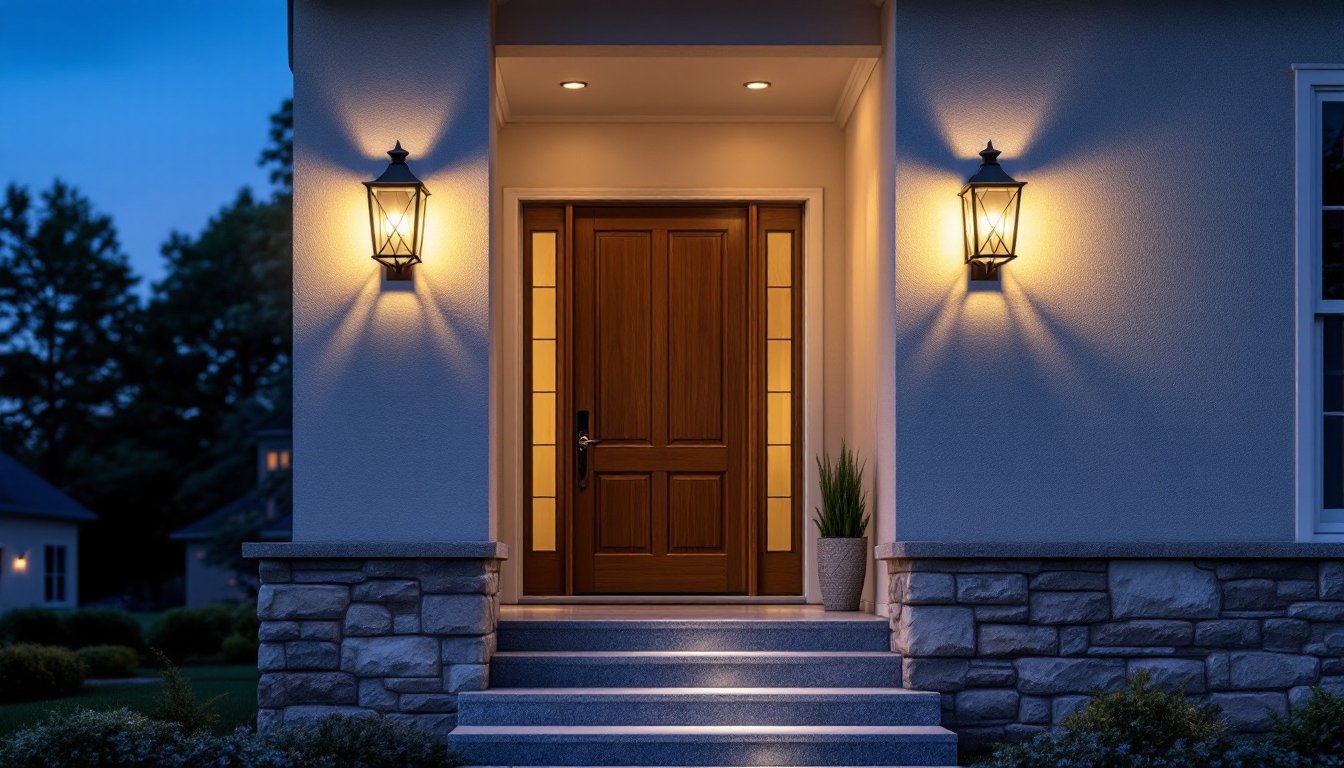
Traditional sconces lean into timeless lines: lantern styles with cross-hatched glass panels, candle-cup designs, and brass or oil-rubbed bronze finishes. These work well on farmhouse, colonial, and cottage-style homes. A lantern-style sconce with clear or frosted glass and a metal cage or frame suits homes with character and history.
Transitional designs blend old and new, clean geometric shapes in finishes like brushed nickel or matte black, but softer lines than pure modern. They’re forgiving. If you’re unsure about committing to a trendy look, transitional sconces fit most homes without clashing. Many homeowners choose transitional as a “safe” middle ground that won’t feel dated in five years.
Modern and Contemporary Options
Contemporary sconces embrace minimalism: clean angles, flush mounting, often integrated LED strips or simple geometric shapes. Linear sconces (rectangular or strip-style) project light horizontally and suit modern architectures, especially those with clean sightlines. Materials tend toward black, stainless steel, or brushed aluminum.
Modern sconces often integrate smart features, think dimmable LEDs or motion sensors. They’re ideal if your home has a minimalist aesthetic or contemporary siding. The trade-off: they can look cold if your home is warm-toned or traditional. Home Depot Outdoor Lighting: showcases both camps, so browse the categories to see which resonates.
Pick a style that matches your siding and architectural details. A Victorian home with ornate trim looks wrong with a sleek aluminum sconce. Conversely, a mid-century modern home clashes with a heavy brass lantern. The good news: plenty of options exist in every price range and style category.
Installation and Placement Best Practices
Placement is half the battle. Mount sconces 36 to 48 inches above the ground for entryway doors, high enough to light faces without creating shadows, but not so high that light falls straight down and misses the pathway.
For side-by-side arrangements (flanking a door or patio), space them 24 to 36 inches from the door frame or focal point on each side. Symmetry matters visually, so measure twice before drilling.
Installation requires basic tools: a stud finder, a drill with bits, a level, and possibly a drywall anchor kit if you’re not hitting a stud. Most sconces come with a mounting bracket and hardware: read the manual for your specific model.
- Locate studs using a stud finder. Fastening into a stud is always stronger, but if placement doesn’t line up, heavy-duty toggles or lag bolts in drywall work if the fixture weighs under 10 pounds. For heavier sconces, use expansion bolts rated for your fixture’s weight.
- Turn off power at the breaker if you’re wiring into existing circuits. Wear safety glasses and gloves.
- Mark holes with a pencil, then drill pilot holes (slightly smaller than your fastener). This prevents cracking, especially in old stucco or masonry.
- Mount the bracket, then slide or connect the fixture itself according to manufacturer instructions.
- Test for level before final tightening. A crooked sconce looks sloppy.
Wiring can be straightforward if you’re connecting to an existing outlet or switch circuit. Some sconces are plug-in ready (less common outdoors, but they exist). Others require running wire through the wall or along conduit, which demands comfort with electrical work or a licensed electrician. Your local electrical code (NEC) dictates outdoor circuit requirements, GFCI protection (ground-fault circuit interrupter), and wire gauge. If you’re uncertain, hire a pro, a service call costs less than rewiring a safety mistake.
For renters or those leaning toward non-permanent solutions, hardwired solar sconces or battery-powered LED sconces skip the electrical work entirely. Results vary: high-end solar sconces work better than bargain-bin versions, but understand that solar and battery lights won’t match the brightness of hardwired fixtures.
Lighting Levels and Brightness for Different Areas
Brightness is measured in lumens. Don’t confuse lumens (light output) with watts (energy use). A 60-watt incandescent bulb produces ~800 lumens, but a 9-watt LED bulb produces the same lumens. LED sconces list lumens right on the package: look there first.
Entryway sconces typically need 400–600 lumens per fixture to light a door and immediate surroundings clearly. Pair them (one on each side of a double door), and you’ve got functional light.
Patio or seating areas want more ambient light, think 600–1000 lumens per fixture if you have several sconces, or 1000+ lumens if you’re relying on one or two bright ones. The key is even coverage so no areas feel dark or uncomfortable.
Pathway or accent lighting calls for gentler brightness: 200–400 lumens. You’re not trying to light a parking lot: you’re guiding eyes and feet without washing out plantings or architectural details.
Color temperature matters too. Warm light (2700K, a warm white) feels inviting, suits traditional homes, and pairs well with landscaping. Cool white (4000K–5000K) feels more security-focused or modern and works better for contemporary styles. Most homeowners prefer warm sconces on residences: cool white looks industrial.
LED bulbs last 15,000–50,000 hours (15+ years in some cases), so upfront cost is worth it. If a sconce requires a specific bulb type, confirm the lumens and color temperature before installing. A fixture that’s too dim or too harsh is wasted money.
Materials, Durability, and Maintenance Tips
Outdoor sconces battle UV exposure, moisture, temperature swings, and salt spray (if coastal). Materials matter.
Aluminum resists rust and is lightweight, but cheaper alloys dent and fade. Stainless steel is corrosion-resistant and durable but pricier. Brass or copper develop a patina over time, some love it, some hate it. Resin or composite materials mimic wood or other finishes without rotting. If you choose painted finishes (black, bronze, white), confirm the paint is rated for exterior UV exposure: interior paint flakes and chalks outdoors.
Glass panels should be tempered or borosilicate for durability and thermal shock resistance. Cheap glass cracks in freeze-thaw cycles. Polycarbonate stands up to impact better than glass but yellows over time.
Gaskets and seals keep moisture out. Check that your sconce has rated-for-wet-location gaskets if it’s in a high-spray area (near a pool, patio shower, or coastal zone). Wet-location rated fixtures are built to handle water ingress without shorting or corroding.
Maintenance is minimal. Wipe glass and fixtures with a soft cloth every few months to remove dust and salt spray. In coastal areas or near the ocean, rinse with fresh water quarterly. For brass or copper, decide if you want the patina polished away (use a soft cloth and brass cleaner) or left to age naturally, both are valid.
LED sconces draw little current, so sockets and wiring last longer than they do in incandescent setups. Dusk to Dawn Outdoor discusses automation features that reduce manual on/off, further extending component life.
Budget-friendly sconces ($40–$80) often use thin-gauge metals and basic glass, fine for mild climates, riskier in harsh ones. Mid-range ($100–$250) balances durability and cost. High-end ($250+) fixtures use premium finishes, superior gaskets, and architectural-grade materials. Invest according to your climate and how long you plan to stay. A sconce on a rental might not warrant a $300 fixture: one on your forever home does.