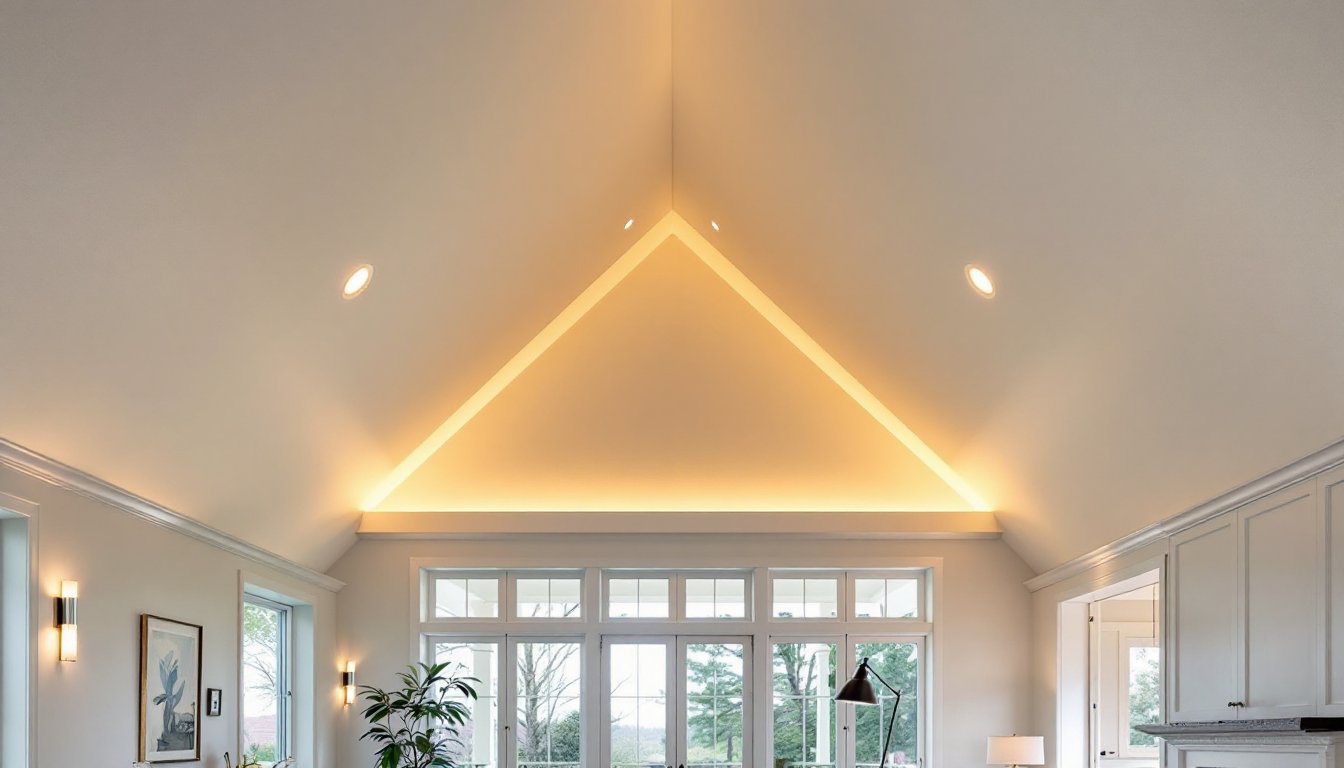
Vaulted ceilings are a stunning architectural feature, they make rooms feel expansive and grand. But they also present a unique challenge when it comes to lighting. Standard recessed lights don’t work well on angled or sloped ceilings because they’re designed for flat surfaces. The good news: recessed lighting for vaulted ceilings is entirely achievable with the right fixtures, planning, and techniques. This guide walks you through everything a DIYer needs to know, from fixture selection to installation and design tips.
Table of Contents
ToggleKey Takeaways
- Vaulted ceiling recessed lighting requires specialized angled trim rings or adjustable gimbal fixtures to sit flush on sloped surfaces and eliminate gaps that plague standard recessed lights.
- IC-rated (insulation contact) recessed housings save critical space on vaulted ceilings by allowing insulation to touch the housing, eliminating the need for 3–12 inches of clearance.
- Use the 1.5x spacing rule as your baseline, then tighten spacing by 10–15% on vaulted ceilings because angled surfaces scatter light differently than flat ones.
- LED recessed fixtures are the safest choice for vaulted ceilings due to lower heat output and longer lifespan (25,000+ hours), reducing the need for replacement in hard-to-reach spaces.
- Aim for 2–3 lumens per square foot in living spaces and 3–5 lumens per square foot in kitchens, but reduce brightness on vaulted ceilings because ceiling height and angle multiply perceived brightness.
- Layer your recessed lighting with wall sconces, pendant lights, or table lamps and install dimmer switches to create depth and let occupants adjust ambiance for the best vaulted ceiling results.
Understanding Vaulted Ceilings and Lighting Challenges
Vaulted ceilings come in several styles, cathedral ceilings (symmetrical peaks), barrel vaults (curved), and sloped ceilings that angle upward from one wall. Each style throws a wrench into standard recessed lighting placement.
The main challenge: standard recessed lights sit flush in a flat soffit. On a sloped ceiling, the fixture trim ring won’t sit flush, leaving gaps and looking unfinished. Light also spreads unevenly on angled surfaces, creating dark spots on the high side and washout on the low side.
Worse, vaulted ceilings often have limited attic or rafter space above them. You need clearance between the fixture’s housing and insulation, typically 3 inches minimum, though some energy codes require 12 inches in certain climates. If your rafter cavity is shallow, standard recessed housings won’t fit.
These challenges aren’t deal-breakers, but they demand upfront planning. Choosing the right fixture type and calculating proper spacing makes all the difference.
Types of Recessed Lights Best Suited for Vaulted Spaces
Not all recessed lights work on vaulted ceilings. You’ll want to focus on fixtures designed or adaptable for angled surfaces.
Standard Recessed Housings come in shallow, standard, and deep depths (typically 4-7 inches). Most are designed for flat ceilings and aren’t ideal for slopes. But, they can work if your rafter cavity is deep enough and you accept some trim ring misalignment.
IC-Rated Housings (insulation contact rated) allow insulation to touch the housing, which saves space. This matters on vaulted ceilings where clearance is tight. Look for the IC label on the housing, it means you don’t need 3-12 inches of clearance around it.
Adjustable Trim Rings and Angled Escutcheons are game-changers on sloped ceilings. Some manufacturers sell angled trim rings (available in 15°, 30°, or 45° angles) that sit flush on sloped surfaces. These cost a bit more than standard trim rings but eliminate gaps and look professional.
Angled Recessed Lights and Adjustable Options
If you’re installing on a sloped ceiling, angled or adjustable recessed lights are your best bet. Adjustable recessed lights feature a gimbal mechanism, the trim ring and light assembly tilt up to 45°, so you can angle the beam even if the fixture itself is perpendicular to the slope. This solves two problems at once: the trim sits flush, and you control the light direction.
Some manufacturers offer specific sloped-ceiling kits that include angled housings and matching trim rings. These are pricier but guarantee compatibility. Before buying, confirm your ceiling angle and verify the fixture’s adjustment range matches it.
LED recessed fixtures are lighter and generate less heat, which is safer on vaulted ceilings where ventilation can be poor. They also last 25,000+ hours, so you won’t be climbing a ladder to replace bulbs in tight spaces anytime soon.
Planning Your Layout: Spacing and Placement Considerations
Layout is where most DIYers stumble. A poorly spaced recessed lighting plan leaves dark corners or creates a disco-ball effect.
Start with the slope. Measure the angle of your ceiling using a protractor, level, or phone app. On a cathedral ceiling, note that both slopes angle differently from a single flat reference line. On a barrel vault, the curve is continuous and demands a different spacing strategy than straight slopes.
Use the 1.5x rule as your baseline. Space fixtures 1.5 times their trim diameter apart. A 6-inch trim ring means fixtures roughly 9 feet apart. On vaulted ceilings, tighten spacing by 10–15% because angled surfaces scatter light differently than flat ones.
Place fixtures perpendicular to your walls. On a sloped ceiling, run fixture rows parallel to the ridge line (the peak). This creates visual order and balances light across the slope. Avoid random placement, it looks amateurish and creates dead zones.
Height matters. On a cathedral ceiling, place fixtures higher up the slope (closer to the peak) for even distribution. On a barrel vault, cluster fixtures around the lowest curve point for fill light, then add supplementary fixtures higher up for depth.
Sketch it out on paper first. Include the ceiling outline, slope angle, and proposed fixture positions. This takes 15 minutes and prevents costly mistakes. Photo apps like recessed lighting placement guides can help you visualize spacing before drilling.
Installation Tips for DIY Projects and When to Call a Professional
Installation difficulty depends on your ceiling access and electrical skills. Be honest: if you’ve never worked with electrical framing or wiring, hire a licensed electrician. Miswiring a fixture creates fire risk and voids warranties.
DIY is feasible if:
• You have safe attic or rafter access and can navigate it safely with a headlamp and work light.
• You’re adding fixtures to an existing circuit (and a licensed electrician confirms the circuit has spare capacity).
• You’re comfortable running new Romex cable in conduit through rafters.
• You understand basic electrical safety: kill power at the breaker, test for live wires with a non-contact voltage tester, and wear safety glasses.
Hire a pro if:
• The job requires new circuits or a sub-panel upgrade.
• Your attic is cramped, poorly ventilated, or inaccessible.
• You’re unsure whether your rafter cavity accommodates the housing depth.
• Local code requires a licensed electrician (many jurisdictions do for hardwired fixtures).
Basic DIY installation steps (assuming electrical work is done):
- Cut rough openings from the room below using a drywall saw. Mark fixture locations on the ceiling surface using a pencil and layout measurements. Use a stud finder to avoid framing members, then cut holes (usually 4–6 inches, depending on the fixture).
- Check rafter clearance from above. Measure cavity depth and verify the housing fits without touching insulation or framing.
- Secure the housing with the provided braces or brackets. Ensure it’s level and doesn’t press against insulation if non-IC rated.
- Wire the fixture (if an electrician hasn’t already). Connect the wire nuts, tuck excess wiring neatly, and secure cables with staples every 4.5 inches.
- Insulate around the housing if IC-rated and insulation is present. If non-IC, maintain the minimum 3-inch clearance by pinning insulation back.
- Install the trim ring and bulb assembly from below. Confirm everything sits flush and aligns with the slope.
- Test before closing drywall seams. Flip the breaker, check for light, then verify no heat buildup after 15 minutes of operation.
Check recessed lighting housing options to match your cavity depth and ceiling type. Installation is straightforward once the right fixture is chosen.
Achieving the Right Lighting Ambiance and Brightness
Vaulted ceilings amplify light, the angled surfaces reflect and diffuse it unpredictably. What works on a flat 8-foot ceiling won’t replicate on a vaulted one.
Brightness (lumens) is your first lever. Most designers aim for 2–3 lumens per square foot on recessed fixtures in living spaces, and 3–5 lumens per square foot in kitchens or task areas. On a vaulted ceiling, go toward the lower end of the range because ceiling height and angle multiply perceived brightness.
Color temperature sets the mood. Warm white (2700K) feels cozy and works best in bedrooms and living rooms. Cool white (4000K–5000K) feels crisp, ideal for kitchens and home offices. The slope of your ceiling and wall colors affect how warm or cool light feels, test a sample fixture before committing to a full install.
Dimmer switches are essential. Recessed lights on vaulted ceilings vary in brightness perception depending on where you sit. Dimmers let occupants adjust ambiance on the fly. Install dimmer-compatible LED bulbs (not all LEDs play nice with dimmers, check the packaging).
Layer your lighting. Recessed lights alone won’t fill a vaulted space. Pair them with wall sconces, pendant lights, or table lamps to create depth and shadow, which makes the vault feel grand rather than bland.
Cost varies widely. A single recessed fixture housing runs $20–$80, trim rings $10–$30, and bulbs $5–$25 depending on LED quality. How much it costs to install recessed lighting depends on whether you DIY the installation or hire an electrician, circuit complexity, and fixture quantity.
Conclusion
Recessed lighting for vaulted ceilings is achievable and transforms how a room feels. The key is choosing the right fixture type, angled trim rings or adjustable gimbal housings make all the difference on sloped surfaces. Plan your layout carefully, measure twice, and don’t skip the electrical groundwork. If wiring intimidates you, hire a licensed electrician: it’s worth the cost for safety. Layer your lighting, use dimmers, and don’t be afraid to test before finalizing your design. A thoughtfully lit vaulted ceiling becomes one of your home’s best features.